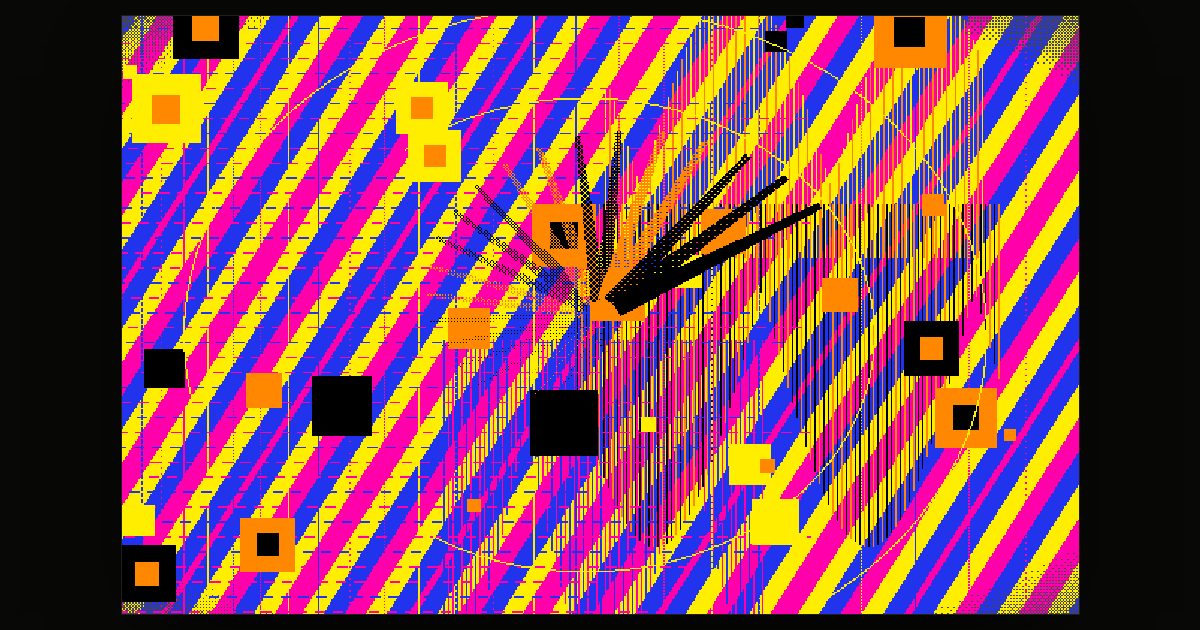
In 1986 Samia Halaby bought a Commodore Amiga and taught herself to code, because it was the one home computer that could hold a real range of colour. She wrote programs that paint, wired several of them to each key, and performed the results live against improvising musicians. She called them kinetic paintings. This is a tribute to that instrument, and you can play it here.
It is a pattern old enough to be boring, and it keeps happening anyway. A new machine arrives, it is sold as a tool for work, and within a few years someone is using it to make something nobody could have made before.
Halaby is a clean example because the constraint is so visible. The Amiga could hold thirty two colours at once and a frame 320 pixels across. She did not treat that as a limit to apologise for. She wrote programs whose whole job was to fill that frame with flat, clashing plates of colour, and then she played them — the keyboard, in her words, became an instrument.
Once my app began running, the keyboard became an abstract painting piano.Samia Halaby
The same thing happened again in 2024, at the other end of the scale. Flow, a feature about a cat in a flooded world, was made entirely in Blender — free, open source software that anyone can download — and rendered in EEVEE, its real time engine. It won the Academy Award for Best Animated Feature, the first Oscar Latvia has ever won. Accepting it, the director Gints Zilbalodis said that any kid now has the tools used to make Academy Award winning films.
Neither of those is a story about software being clever. They are both stories about the distance between having something to make and being able to make it getting shorter. That is the only reason we build Nima.
The mechanism is hers, taken from her own description of it rather than invented for the occasion. Three things carry it:
The painting is ours, not hers. The shapes are read off her frames — plates packed with hairline stripes running on the plate's own axis, hatch fine enough to shimmer against itself, lattices of dashed line, combs of uneven verticals — but no work of hers is reproduced here, and nothing here is a reconstruction of a particular piece.
Nima is an animation studio in a browser: you describe a scene, and it builds and renders it. Same instinct, different machine. Try it free.
Samia Halaby is a Palestinian American painter, born in Jerusalem in 1936, and a pioneer of computer art. Her work is at samiahalaby.com, and it is worth your time. Photograph on the About panel by Lbalbalba11122, CC BY-SA 4.0. This page is a tribute made by admirers and is not affiliated with or endorsed by her.