Book to screen: adapt your own novel as an animated series
A novel reaches the screen in one of two ways. The traditional way is to sell an option on the screen rights and wait for a producer to make it, and most optioned books are never made. The other way is to adapt it yourself as an animated series. In Nima's Long-form Video you paste a chapter, pick a look, approve the cast it draws from your descriptions and choose the voices, and it films the text word for word, with a narrator and with each character speaking their own lines. The first trailer is free, and longer films are made on a monthly plan by the minute, from as low as $10 per finished minute.
Your first trailer is free.
Two routes from book to screen
| Sell an option | Adapt it yourself as an animated series | |
|---|---|---|
| Who decides if it gets made | A producer, then a studio or streamer | You |
| Who writes the adaptation | A screenwriter, who will change it | Nobody. Your text is the script |
| How faithful it is | As faithful as the screenwriter and the budget allow | Every word, unless you agree to a cut |
| What it costs you | Nothing. It pays you a fee, typically $2,000 to $25,000 | A monthly plan by the minute, from as low as $10 per finished minute |
| What you have at the end | Usually an expired option | Episodes you own, on your channel |
The two are not rivals. Plenty of authors would take the option and make the series as well. But only one of them is in your hands.
How the option route works, and how often it ends in a film
An option is a rental of your screen rights. In the words of a lawyer writing for Jane Friedman, "the producer options the exclusive rights for a specified time to develop your creative work", and at the end of that time "must either drop the project or purchase the story rights". The Authors Guild puts typical option fees at $2,000 to $25,000 for a customary first term of 18 months. If the film is made, the purchase price is often 2.5% to 5% of the production budget.
Most options end without a film. There is no official count, but the people who work with authors agree. Jane Friedman: "Very few options ever result in movies, meaning the option payment is rather like free money." Writer Beware: "The vast majority of options expire long before any movie deal can be struck."
And nobody commissions an animated series for one author. An American 2D television series typically cost $1 million to $2 million an episode when Anime News Network added it up in 2015.
What an adaptation does for a book
A screen version is the strongest advertisement a book can have, which is why authors want one. Publishers Weekly reported in April 2026 that sales of People We Meet on Vacation rose 97% in the two weeks after its film came out, that Agatha Christie's The Seven Dials Mystery sold four times as many copies after its series began, and that sales of the Bridgerton novels tripled alongside the fourth season.
Those are studio releases. An author-made animated series is new, so its numbers have not been written yet. What is certain is that your story will exist in a form people can watch, share and stumble across.
Adapting it yourself
The most faithful adaptation a novel can have is one that keeps the whole text. That is what an animated audiobook is: a narrator reads your prose, your characters speak their own lines on screen, and every scene is staged in the rooms you described.
The episode at the top of this page is the opening of Pride and Prejudice done this way, chapters one and two in fourteen minutes. Our Sherlock Holmes story runs an hour. Chapter one of Little Women runs twenty-five minutes. None of them has a screenwriter.
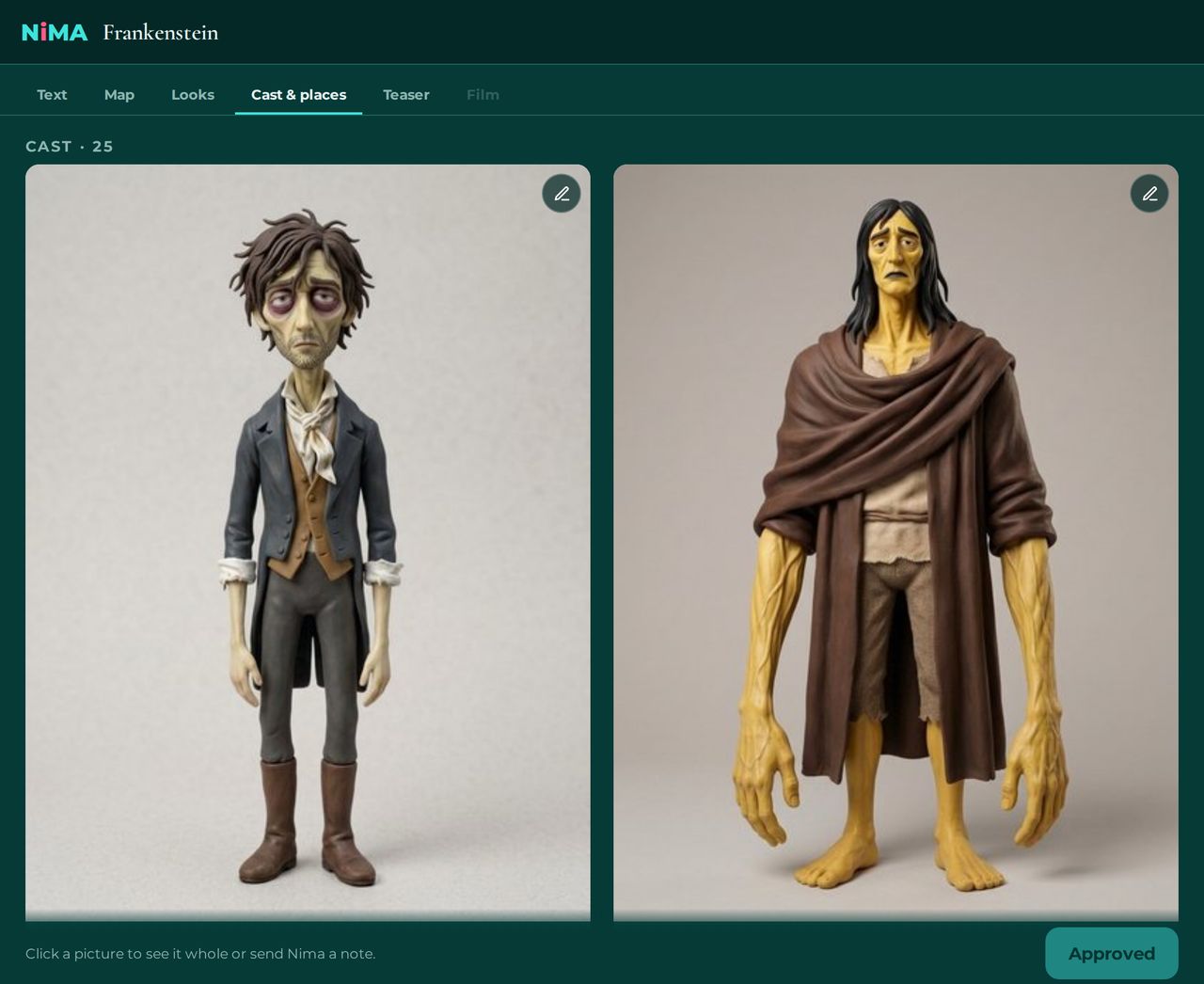
- Your cast, fixed. Every character is drawn once from your description and kept the same in every episode. You approve each one before anything moves.
- Your dialogue, performed. Each character gets a voice you choose from five auditions, and their mouth moves with the line.
- Your structure. A chapter becomes an episode. The book's order is the series' order.
- Your call. Nothing is cut unless you agree, and you review a full draft before the final render.
How long your novel is on screen
Narrated film runs at about 150 words a minute, so the arithmetic is simple:
| The text | On screen | As episodes of about 15 minutes |
|---|---|---|
| A 2,000-word chapter | About 13 minutes | One episode |
| A 9,000-word short story | About an hour | Four episodes |
| A 50,000-word novella | About five and a half hours | About 22 episodes |
| An 80,000-word novel | About nine hours | About 36 episodes |
Nobody has to make all of it at once. One upload is a chapter or so, and a plan is two, ten or a hundred minutes a month, so a series is built the way a serial was written: an episode at a time, starting with the first chapter.
A finished film is the strongest pitch there is
In film and television, people who want a project made do not send the script alone. They make a proof of concept, which StudioBinder defines as "a short film composed of scenes that best represent the concept, story, tone and themes of a potential feature film or television series". The reason is simple, in the same source's words: "People with resources and money are much more likely to invest in your product if they are able to see a proof of concept rather than simply a screenplay or treatment."
A director's proof of concept is a few minutes long. Until now a novelist could not make even that. With Long-form Video you can make the chapter, the episode or the whole story, and put it where anyone can watch it.
And an audience is what gets attention. The pattern has repeated often enough to be worth knowing:
- Hazbin Hotel began as a 31-minute animated pilot that its creator released on YouTube in October 2019. It has passed 123 million views. A24 picked it up the following year, and it premiered as a series on Amazon Prime Video in January 2024.
- The Martian was published as a serial on Andy Weir's blog, then as a 99-cent Kindle book that sold 35,000 copies in three months. Twentieth Century Fox optioned it in 2013 and the film came out in 2015.
- Wool was self-published by Hugh Howey through Kindle Direct Publishing. The film rights sold in 2012, and it reached the screen as Silo on Apple TV+ in 2023.
In each case the audience came first and the industry followed. What you do with a film of your own book is yours to decide:
- Release it on YouTube as a series, an episode at a time, and build the audience there.
- Put the link in your queries and pitches, so the person deciding can watch instead of read.
- Screen it at readings, festivals, book clubs and schools.
- Make it the centrepiece of a crowdfunding campaign for the rest of the series.
- Give every book in a series its own opening episode.
- Something nobody has thought of yet. The tool is new, and so is what it makes possible.
How to do it
- Paste your pages. Open Long-form Video and paste the scene, chapter or short story you want filmed, between 150 and 10,000 words. Nima reads it, maps the scenes, the cast and the places, and asks before it cuts anything.
- Pick a look. Detailed claymation, felted wool, comic book ink, acid pencil, which is coloured pencil, or paper love, which is cut paper. Nima can draw your lead character and your main location in all five so you compare them side by side.
- Approve the cast and the places. Every character is drawn once, from the descriptions in your text, and every location is built once as a set. Leave a note on any picture and Nima redraws it.
- Pick the voices. Each speaking character gets five voice auditions, each one reading a line from your book. Choose the one that sounds like the person you wrote.
- Watch your free trailer. Nima cuts a trailer of 15 to 20 seconds from your text: several of its places and people, two or more of your lines spoken word for word, music under it, your title at the end. You see it first as a storyboard with the voices, give one round of notes, then start a free 7-day trial and it is fully animated. Nima emails you when it is ready.
- Make the film, if you want more. Pick a plan, metered in minutes of finished film, and Nima films the text scene by scene. You review a full draft with the voices, leave notes in each round your plan includes, then approve the render. The finished film is yours to download and share with a link.
For an adaptation, keep the narrator on so the prose is read as well as the speech, and start with chapter one. It is the pilot.
Before you start: check who holds the screen rights
You can only adapt what you hold the rights to. If you self-published, they are yours: Amazon's KDP terms, for example, take a non-exclusive licence to print and distribute and say you keep every other right in your book. If you have a publisher, look in your contract for film, television or dramatic rights. The Authors Guild advises authors never to grant those to a publisher, so you may well have kept them. If you have already sold an option, the producer holds the exclusive right until it expires, so ask first.
Formats and extras
Films come in widescreen and in vertical, so the same trailer fits YouTube and your book page as well as TikTok, Reels and Shorts. Music can be added. A title card for your book, your own artwork for the characters and your own voice for the narration are available on request. Write to hello@nima.mov and tell us what you need.
Common questions
How do I get my book made into a movie or series?
Two ways. You can sell an option on the screen rights to a producer, usually through an agent, and wait to see whether it is made. The Authors Guild puts typical option fees at $2,000 to $25,000, and most options expire without a film. Or you can adapt it yourself: Nima's Long-form Video films your text chapter by chapter as an animated series, with a narrator and a voice for each character.
Can I adapt my own book for the screen?
Yes, if you hold the screen rights, which you do unless you have sold or optioned them. In Nima's Long-form Video you paste a chapter and it films the text word for word as animation, with a narrator and a voice for each character.
How much does it cost to adapt a novel as an animated series?
With Nima's Long-form Video films are made on a monthly plan metered in minutes of finished film, from as low as $10 per finished minute. Film runs at about 150 words a minute, so a 2,000-word chapter is about 13 minutes. The first trailer is free.
How long would my novel be as an animated series?
About one minute of film per 150 words. An 80,000-word novel is about nine hours, or roughly 36 episodes of 15 minutes, made one episode at a time.
Will an animated adaptation change my story?
No. Spoken lines come only from your text, a narrator reads the prose, and nothing is cut unless you agree to it.
What is a proof of concept for a book adaptation?
A short film that shows what the full project would be like. People with money are, in StudioBinder's words, much more likely to invest if they can see one than if they are handed a screenplay. With Nima's Long-form Video an author can go further and make the chapter, the episode or the whole story.
Can a series on YouTube lead to a screen deal?
It has happened. Hazbin Hotel began as an animated pilot on YouTube in 2019, passed 123 million views and became an Amazon Prime Video series in 2024. The Martian and Wool were self-published before studios bought the rights. In each case the audience came first.
Do I keep the screen rights if I make my own adaptation?
Yes. Making your own animated version does not transfer any rights to anyone.
Chapter one is your pilot. See its trailer for nothing. Make my free trailer.